The Pleasing Crisis of a Noun by Johny Lamb

By Darren Hayman

danceband-500

There are several ways of approaching the noun ‘folk’, and we use it carelessly and variously. We use it with prefix when it strays too far from its perceived meaning (alt, new, weird etc), and we’ll add things to the end when it gets even further away from us (-tronica, or just -ie or -y). This aside, there are perhaps two useful routes into the noun. One being that music of unknown authorship, passed on aurally through the generations, or at least that music that survived the scrupulous moral agency of Cecil Sharp and his contemporaries, and the other, best described as a vernacular or popular music that voices the identity of a community (contemporary or otherwise). These two approaches might well contain each other, or be some way distant.

Mostly, I suppose, that what we call folk is music that sounds like folk. For the most part this works for us, but when presented with a project such as Darren’s here, we are forced to acknowledge, and to some degree reconcile the chasms of ideological, aesthetic, technical and methodological difference between various contemporary practices. And even in writing that sentence, my use of ‘us’ and ‘we’ in this text so far suddenly becomes problematic. Who is this ‘we’? Or to put it rather better by using the words of poet John Hall, ‘Who are you a we with?’ Indeed, who am I, or is Darren, a we with? ‘Bugbears’ is an album of traditional songs, but then so is ‘Broadside’ by Bellowhead, and yet, the two are not siblings. Likewise, Darren is at once doing the same thing and not the same thing as Jackie Oates. The difference, I think, lies in re/deconstruction and appropriation. It also lies in a variable take on the idea of authenticity. And thus, ultimately, the cultural resonance of any practitioner of folk music comes down to the generation and reception of meaning.

In the circles that encompass Bellowhead, Oates et al, there is much talk of authenticity, and it seems that instrumentation, arrangement, language, voice and repertoire play a big part (Bellowhead’s incongruous brass players notwithstanding). The voice is of particular interest here, where delivery will often take on the form of a regionless, quasi-pastoral timbre and ‘accent’, which you will also find rife in the singers on historical dramas from the television (think of Sharpe’s Daniel Hagman, or someone taking up a song at the end of an episode of Larkrise to Candleford). Technique and ornamentation play a large role here (instrumentally as well as in the voice). Production for these kinds of traditional players plays to those notions of transparency that manufacturers of recording equipment have been promising for decades. Things are clean and allow us to bathe in the skill, dexterity and knowledge of the players. The set of more problematic performers that might include Darren seem to understand and embrace the idea that recording, production and fidelity have compositional value in and of themselves. Furthermore, the voice is unaffected (or

Martin Said – Video

Niklas Vestberg (Fulhäst, formerly half of Moustache Of Insanity) introduces the video for Darren’s Martin Said, from Bugbears.

Drinking…fighting…dancing

“Would you make a quick quirky cheap video for me?”

” A collection of 17th Century Songs… maybe you should choose the weirdest”

“I wasn’t thinking a full on video effort.. something quite lateral in approach. Something odd and possibly experimental”

Part of me kind of wish more music video proposals came with instructions like that – don’t make much of an effort, pick the song yourself, make it weird. Sure, the 17th Century bit was a bit of a concern. How do you even start?

In the end I picked the first track of the album. Not because it was short (but, thankfully it was) and not because I couldn’t be bothered to sit through a whole album of 17th Century songs (because I did. I listened to it all, I promise) but simply because it was my favourite track and it just resonated with me. It was probably the drinking bit, since I had being doing a fair bit of that over the past few months.

The decision to use found/public domain footage was kind of obvious. I didn’t want to film anything myself; it just didn’t seem right. So I started sifting through public domain footage on the internet, searching for clips tagged with alcoholism, drinking, parties and similar terms. Of course I wanted the clips to be interesting, but at the same time I really didn’t wanted it to be about the actual images. Bug Bears is a beautiful album, but it’s also bloody hard work and I wanted the video to reflect that. Eventually I found myself with a bunch of suitable clips and started playing around with them. Should I cut it to the beat, try to make it reflect the lyrics somehow? It just didn’t seem to work and the clips quickly became uninteresting. So I decided against all these normal conventions and started playing around with fixed clip lengths, eventually settling on one second. It seemed to work. It was long enough for the brain to start processing what was on screen, but short enough to make you work that little bit extra. I think it works. It’s unlike any other video I’ve ever done, but I’m quite pleased with the end result. Sure, it’s pretty unwatchable, but I also find it strangely appealing and almost hypnotic. Drinking, fighting, dancing, drinking, fighting, dancing.

Occupation Show 3

The Vortex has seating at the front and standing at the back, seating will be allocated based on the order tickets are sold and reserved for you when you arrive.

If the number of tickets remaining above shows fewer than 25 we cannot guarantee you will get a seat.

http://www.wegottickets.com/event/228613

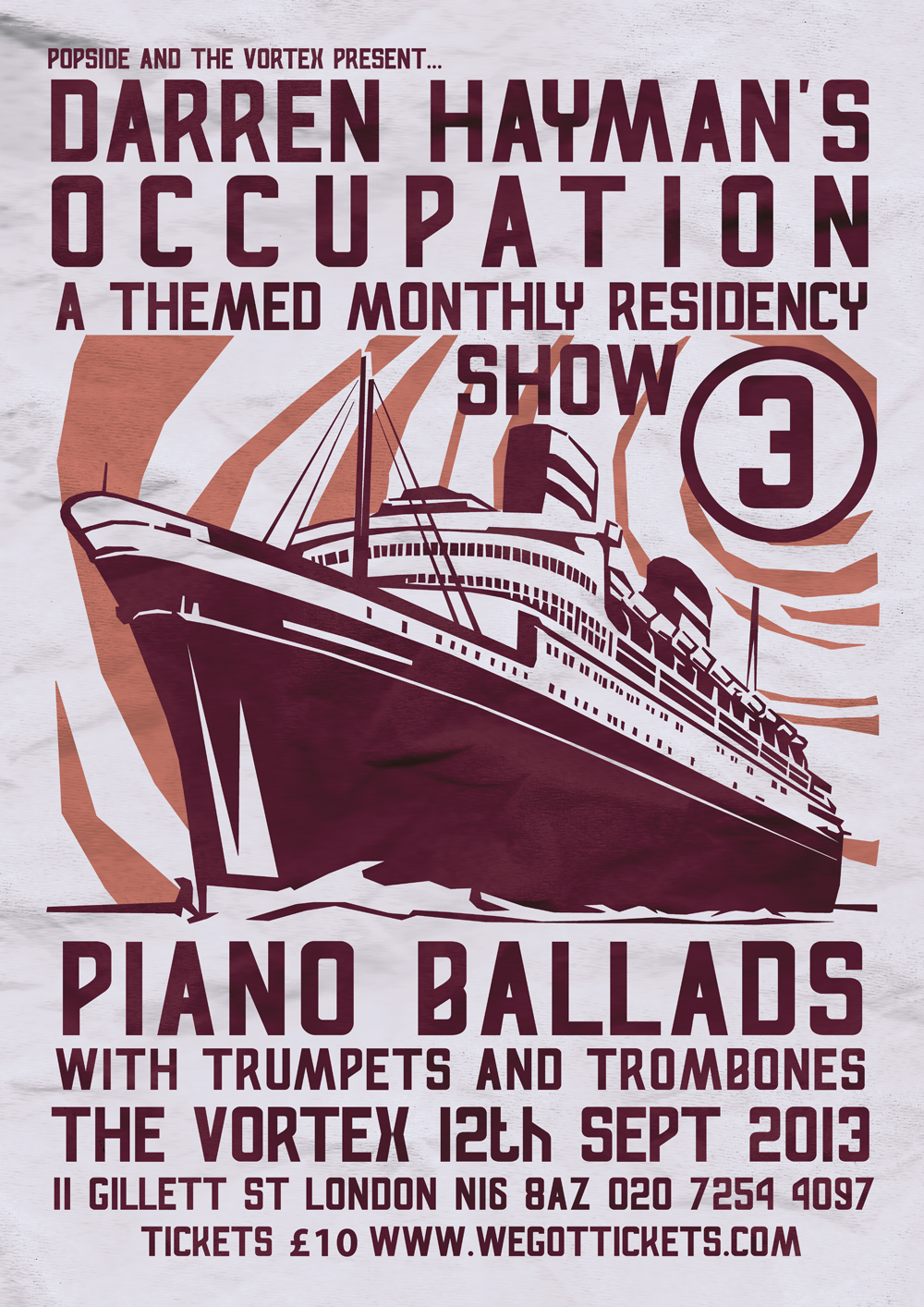
Popside and The Vortex Present…

Darren Hayman’s Occupation

Show Three – Piano Ballads with Trumpets & Trombones

Thursday 12th September 2013 The Vortex

“The third Occupation show is themed around piano ballads. The majority of the songs will be taken my album The Ship’s Piano but I will also be visiting other softer moments from my back catalogue, including some rarely played Hefner songs.

I will be accompanied by a small Jazz combo including Steve Pretty on trumpet.

My desire to do these Vortex shows came out of my love of the more esoteric regions of jazz and a longing to experiment and stretch out on stage. With that in mind I am delighted to announce that the support for this show comes from Gail Brand and Mark Sanders.

Gail and Mark play free improv music on trombone and drums. A beautiful, courageous sound which I hope will come to mean even a fraction to you as it does to me.

Here is Stewart Lee introducing their music on the BBC 

I hope also to collaborate with Gail and Mark on a new piece on the night.

I hope you can come.”

Tickets are £10 and seating is limited so book early to guarantee yourself a spot and ticket holders will get a poster designed by Darren for each show.

Darren Hayman’s Occupation is a series of shows on the second Thursday of the month at The Vortex, Dalston. There will be a mix of sets showcasing different albums, themes and special guests. This is not your standard indie gig:

“I love gigs. I hate gigs.

I want to play live and I love what shows can be, but I’ve found myself frequently stifled by the limitations of my career. I can’t play the plush, seated venues and I can’t experiment with a string section or play 20 minute opuses.

My music was born in the sticky floored rock venue. I like the sticky floored rock venue but I have had a hankering for something different recently. My own taste has veered towards free improv and jazz and although it’s hard to imagine that music influencing my own I do love the culture of live music in this genre.

Long sets, sometimes two, comfortable venues and a reverence and respect for the event and the moment; less talking, less cameras, more dynamics, less microphones.

I wondered if these would let an indie rock interloper amongst their ranks. My show at the Vortex back in last November was successful enough to make me think of playing a monthly residency there.

The idea is that each show is themed. I don’t want to go the whole predictable route of playing complete albums, but rather group, types of songs together for different evenings. Experiment, sometimes play two sets, sometimes have unlikely guests. I will be playing with members of my bands from through out my career as well as old friends like the Wave Pictures and Allo Darlin.

The Vortex is a beautiful venue. I’m trying to do something different; something, smaller, prettier. I hope you can come.”

The Vortex
11 Gillett Square, London N16 8AZ
www.vortexjazz.co.uk
Doors 8pm
£10 Adv

The World Turned Upside Down

When playing the song Impossible Times from the Violence live, I have been introducing it with a speech about how every age views itself as the nadir of history. That things have never been as bad as they have in the present.

During the English Civil Wars in the seventeenth century this manifested itself as the idea of ‘The World Turned Upside Down’. On my collection of Bugbears this is illustrated in the song ‘Impossibilities’ a list of incongruities and …well impossibilities.

Here are some woodcuts from the era via The New Inquiry.
Original article here

The World Turned Upside Down
By THE PUBLIC DOMAIN REVIEW
The Public Domain Review is an online journal and not-for-profit project dedicated to showcasing the most interesting and unusual out-of-copyright works available on the web. You can explore our curated collections of curiosities and our fortnightly articles from leading scholars, writers, and artists at publicdomainreview.org

up11-383x438


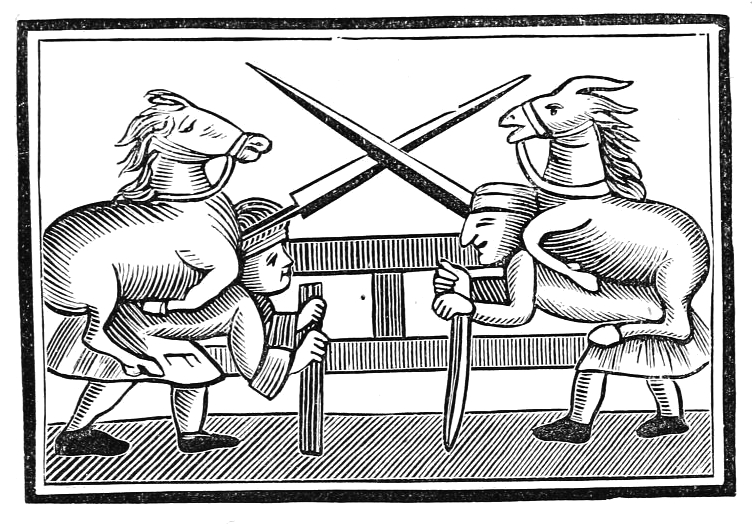
A series of woodcuts from an 18th century chapbook entitled The World Turned Upside Down or The Folly of Man, Exemplified in Twelve Comical Relations upon Uncommon Subjects. As well as the amusing woodcuts showing various reversals (many revolving around the inversion of animal and human relations) there is also included a poem on the topic. The chapbook is reproduced in the wonderful Chapbooks of the Eighteenth Century (1882) edited by John Ashton, which brings together hundreds of facsimiles of 18th century chapbooks upon a huge range of subjects. All images are from the book housed at the Internet Archive, donated by University of Pittsburgh Library System. Click images to enlarge.

up2

No title

up5

Not Title

up4

The ox turned farmer

up3

Old Soldier Turned Nurse

up8

The mad squire and his fatal hunting

up7
The duel of the palfries

up6
The reward of roguery – or the roasted cook
up14

The sun, moon, stars, and earth transposed

up13
The water wonder or the fishes lords of the creation
up12

The horse turned groom

up111

The Honest Ass and the Miller

up10
Gallantry – a la mode – or the lovers catched by the bird

up9

The Ox Turned Butcher

The World Turned Upside Down

By Darren Hayman

up2

When playing the song Impossible Times from the Violence live, I have been introducing it with a speech about how every age views itself as the nadir of history. That things have never been as bad as they have in the present.

During the English Civil Wars in the seventeenth century this manifested itself as the idea of ‘The World Turned Upside Down’. On my collection of Bugbears this is illustrated in the song ‘Impossibilities’ a list of incongruities and …well impossibilities.

Here are some woodcuts from the era via The New Inquiry.
Original article here

The World Turned Upside Down
By THE PUBLIC DOMAIN REVIEW
The Public Domain Review is an online journal and not-for-profit project dedicated to showcasing the most interesting and unusual out-of-copyright works available on the web. You can explore our curated collections of curiosities and our fortnightly articles from leading scholars, writers, and artists at publicdomainreview.org

A series of woodcuts from an 18th century chapbook entitled The World Turned Upside Down or The Folly of Man, Exemplified in Twelve Comical Relations upon Uncommon Subjects. As well as the amusing woodcuts showing various reversals (many revolving around the inversion of animal and human relations) there is also included a poem on the topic. The chapbook is reproduced in the wonderful Chapbooks of the Eighteenth Century (1882) edited by John Ashton, which brings together hundreds of facsimiles of 18th century chapbooks upon a huge range of subjects. All images are from the book housed at the Internet Archive, donated by University of Pittsburgh Library System. Click images to enlarge.

No title

up5

No Title

up4

The ox turned farmer

up3

Old Soldier Turned Nurse

up8

The mad squire and his fatal hunting

up7
The duel of the palfries

up6
The reward of roguery – or the roasted cook
up14

The sun, moon, stars, and earth transposed

up13
The water wonder or the fishes lords of the creation
up12

The horse turned groom

up111

The Honest Ass and the Miller

up10
Gallantry – a la mode – or the lovers catched by the bird

up9

The Ox Turned Butcher

Darren Hayman Interview on Bugbears

This interview by the excellent Drunken Werewolf

Religion, relationships, new towns and open-air swimming pools: Darren Hayman has drawn inspiration from them all. His latest album Bugbears is a collection of seventeenth century folk songs. It continues his fascination with the era which began with last year’s album The Violence chronicling the Essex witch trials and was followed by the Four Queens EP earlier this year.

In an exclusive interview, he sits down with DrunkenWerewolf’s Patrick Widdess to talk about his musical history project and why he wants to break our hearts.

So Darren, how did your fascination with English history in the 17th century begin?

I’m known for my use of contemporary language: slang, idioms, even brand names. I was doing a series of albums about Essex and I had this idea of doing something historical. I thought if I wrote about a story that happened a few centuries ago it would create hurdles in the songwriting process and make me change my approach to words.

Whilst writing The Violence I thought I should include a few folk songs of the time. I didn’t want to make the album sound 17th century but I thought I might learn something from researching them.

Interpreting and recording these songs became a separate project and album that was recorded at the same time as The Violence.

Where does the album name Bugbears come from?

The album includes a poem which was a rare rational treatise for the time. Everything else was about seeing fear and the devil in places. This poem says it’s all a lot of nonsense and to get a grip. It refers to these fears as bugbears. It seemed to capture what the whole album was about: curses and things going wrong.

You’ve changed the band name from The Long Parliament to The Short Parliament for this album. What’s the difference?

There are a few different members. The band I play with is always a little loose. There are seven or eight musicians I work with at different times. In this case I worked with those that had more of a folk leaning, particularly Dan Mayfield, the violin player. He’s from a Morris dancing family – the real deal. Not like us and Mumford and Sons who put on a folk hat when they fancy it!

It was a way to distinguish the two projects. There’s also the rump parliament which I should find a project for.

Yes, it’s a great name! How did you interpret these old songs for a modern audience?

I wasn’t trying to be slavishly accurate. Accuracy with something from as long ago as the 17th century is pretty much impossible. There’s only so much we can know about how these songs sounded.

I also didn’t want to completely reinvent the songs and say, “right, I’ll do them with a jungle beat and modulating synthesisers.” It was a case of making them sound apt without being ridiculously reverential.

So how did you change them?

First, I took lots and lots of words out. One of the fist things that strikes you about these songs is they have 18 verses. Music had a different purpose in those days. It was used to tell stories, even acted as the news. That didn’t seem palatable to a modern audience.

Also there are not many tunes. The same ones are reused repeatedly. It’s like playground or football chants where you keep reinventing the lyric to the same tune. The melody’s not important. They’re sung to taunt the other side and so have a different purpose to songs that entertain. The tunes also consisted of mostly major chords, which grates on the modern ear after a while.

So there were decisions to be made about how much you followed the earliest notated tune. There were decisions about when to adapt or shift slightly and what you could do in the name of interpretation, and what was pure invention. If I was more into folk preservation I would have had a stricter approach but I felt that was not my domain. It was about interpreting them respectfully as an indie-pop singer.

Having studied these old songs have your ideas about the role of music today changed?

Not really. I’m still just trying to write interesting songs, not give them a different use. That’s the challenge with this project; you don’t want to give a history lecture. You want it to still be a song. You want it to be about love or fear, wanting or jealousy because they’re things we all feel and that’s how you hook the listener in.

It’s made me aware of other uses songs have had in history but it’s made me more sure about what my songs are about and what I’m trying to do. Basically, I’m trying to break your heart and find more interesting ways of doing that like writing about Charles the First and Henrietta Maria.

Has the project been successful in changing your song writing style?

It has for me. It’s made me a better writer but now I’m trying to get back to writing a normal album. I’m working on 10 or 12 songs about breaking up – an everyday album about heartbreak. It’s interesting trying to do that after I’ve got used to working with pages of notes around me. I’m hoping there will be an unblockage soon and songs will come spilling out once I’ve got away from the 17th century thing.

So is the project finished now?

There’s one song that Angela McShane, head of 17th century studies at the V and A has asked me to do. I met her just this week.

I was really nervous because the research I do is just about looking for stories and a good tune: “Oh that sounds good I’ll use that!” It’s completely different to the research she’s doing looking at songs and ballads, how they’re printed and whether this lyric is more accurate than that one.

I felt like I was taking liberties with her specialist area, but actually she believes reinterpretation has always been part of the story. Her research involves going through different interpretations to unravel them. So I’m another person in a long tradition of people reinterpreting these songs, which she found interesting. So I’m doing one song, basically for her but I’m sure I’ll put it online.

Finally, what have you got planned for your forthcoming residency at The Vortex?

I sometimes tire of rock gigs and I’ve started going to jazz gigs. There are lots of things that are different aside from the music: longer sets, sitting down, largely unamplified music. I’m trying to do something like that.

Often when you see a band it’s like hearing their CV. They have to include their top O-level scores and the best bits at the end. I want it to be less like that and more “what shall we do tonight?” Each gig will be themed, but not the classic album theme. I don’t like knowing what every song’s going to be in order.

I’m theme-ing my songs into groups, and we’re planning to do 12 gigs over a year. The first is The Violence and Bugbears, then a holiday themed one for August. I’ll do a set of piano songs from different albums and we’ve thought about doing one where the first 14 ticket buyers choose the songs. Then there are the Hefner songs but not a Hefner reunion as such. We haven’t decided all of them but I’m sure the ideas will come to us.

Darren’s residency at The Vortex begins on July 11th. Bugbears is out on July 15th on Fika Recordings.

Darren Hayman Interview on Bugbears

By Darren Hayman

This interview by the excellent Drunken Werewolf

Religion, relationships, new towns and open-air swimming pools: Darren Hayman has drawn inspiration from them all. His latest album Bugbears is a collection of seventeenth century folk songs. It continues his fascination with the era which began with last year’s album The Violence chronicling the Essex witch trials and was followed by the Four Queens EP earlier this year.

In an exclusive interview, he sits down with DrunkenWerewolf’s Patrick Widdess to talk about his musical history project and why he wants to break our hearts.

So Darren, how did your fascination with English history in the 17th century begin?

I’m known for my use of contemporary language: slang, idioms, even brand names. I was doing a series of albums about Essex and I had this idea of doing something historical. I thought if I wrote about a story that happened a few centuries ago it would create hurdles in the songwriting process and make me change my approach to words.

Whilst writing The Violence I thought I should include a few folk songs of the time. I didn’t want to make the album sound 17th century but I thought I might learn something from researching them.

Interpreting and recording these songs became a separate project and album that was recorded at the same time as The Violence.

Where does the album name Bugbears come from?

The album includes a poem which was a rare rational treatise for the time. Everything else was about seeing fear and the devil in places. This poem says it’s all a lot of nonsense and to get a grip. It refers to these fears as bugbears. It seemed to capture what the whole album was about: curses and things going wrong.

You’ve changed the band name from The Long Parliament to The Short Parliament for this album. What’s the difference?

There are a few different members. The band I play with is always a little loose. There are seven or eight musicians I work with at different times. In this case I worked with those that had more of a folk leaning, particularly Dan Mayfield, the violin player. He’s from a Morris dancing family – the real deal. Not like us and Mumford and Sons who put on a folk hat when they fancy it!

It was a way to distinguish the two projects. There’s also the rump parliament which I should find a project for.

Yes, it’s a great name! How did you interpret these old songs for a modern audience?

I wasn’t trying to be slavishly accurate. Accuracy with something from as long ago as the 17th century is pretty much impossible. There’s only so much we can know about how these songs sounded.

I also didn’t want to completely reinvent the songs and say, “right, I’ll do them with a jungle beat and modulating synthesisers.” It was a case of making them sound apt without being ridiculously reverential.

So how did you change them?

First, I took lots and lots of words out. One of the fist